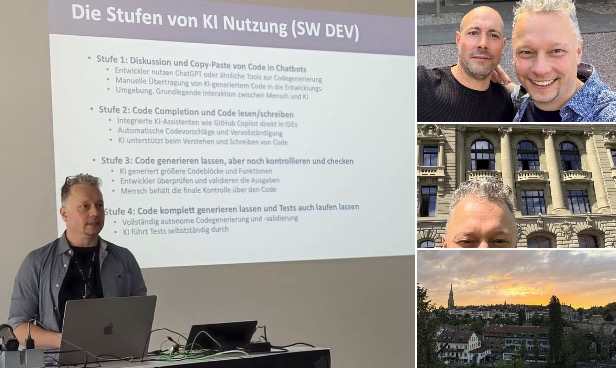
I was invited by Timo Kehrer (Chair of Software Engineering, University of Bern) to give a guest lecture. The focus was on a new engineering discipline: Agentic Harness Engineering.
The thesis: An agent is a model plus harness. The model provides the raw intelligence, the harness everything around it, i.e. context, rules, tools, memory, verification, security and observability. It is precisely this harness for the AI horses that becomes the actual engineering task.
The key question for the students: What remains of classic software engineering when AI is no longer just a tool, but the core of the development process? My answer: contracts, tests, empiricism, models and clean code. Not as relics of yesterday, but as instruments to guide the fast AI horses, i.e. to control the harness as a coachman. The exciting thing is that much of what is already being done in practice has not yet been worked through academically.
We teach the same methodology at Obvious Works in the AI Developer Bootcamp: from model to harness, from bug fix to the question of which capability is missing in the harness, and from green tests to eval pass rate, token efficiency and cost per task.

 DE
DE  EN
EN