
Agentic Coding Hackathon
Take your development team from prompting to real results in 2 to 3 days Agentic Coding: with Claude Code, Codex, MCP and a professional Agent harness. Available for booking as Single-user in an open configuration or as In-House Sprint for the whole team to work on your own codebase.
- ✓Individual or team sprint. As an open course for individual developers or as an in-house course for the entire team.
- ✓From Greenfield to Brownfield. First a green field, then a real inventory code.
- ✓Tool-agnostic, no lock-in. Guidelines for Claude Code, Codex, Aider, and Others.
EU hosting via AWS Bedrock, GDPR-compliant, with no storage or training using your data. More on this · Prices & Reservations
Trusted by leading teams · Over 5,000 trained professionals








The Hackathon at a Glance
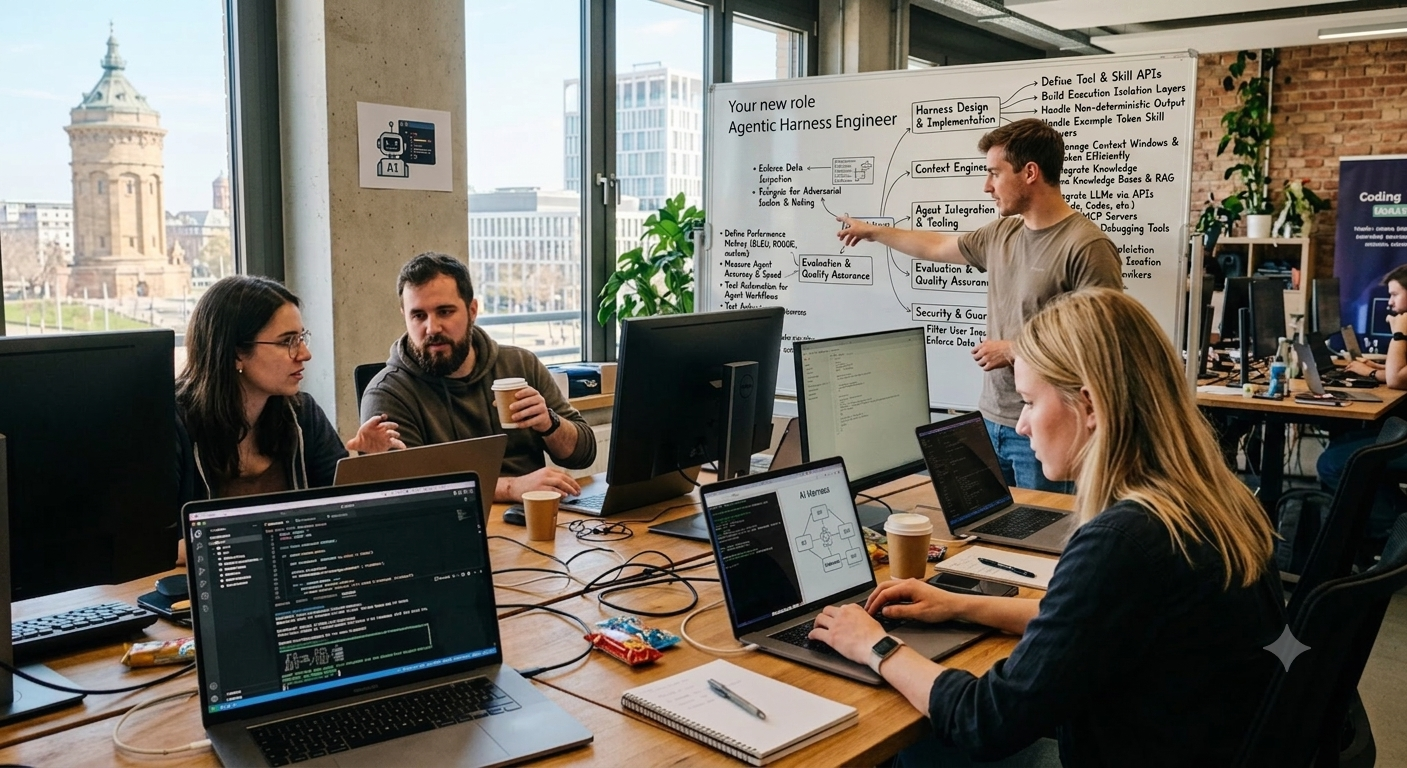
Agentic Coding in 2 to 3 intensive days: Your team will learn to orchestrate entire tasks using AI agents, not just type prompts.
What will your team be able to do after the hackathon? +
After 2 to 3 days: observable, verifiable skills applied to your own codebase.
Context & Control
- ✓designed a project-specific CLAUDE.md
- ✓optimized the context for reproducibility
Build Agents
- ✓configured MCP Server with Your Tools
- ✓delegated Entire tasks to agents
Testing & Quality
- ✓designs TDD Workflows with AI
- ✓ensures Features Based on Tests
Method & Process
- ✓leads Your team with a method
- ✓established A Team Playbook
Who is the hackathon suitable for (and who is it not suitable for)? +
This is perfect for you if …
Not suitable if …
The Transformation in Pictures
Without structure
- ✗Each team member tries out AI tools on their own
- ✗Tool Proliferation: Claude Code here, ChatGPT there, Cursor somewhere
- ✗No common rules; tricks are lost
- ✗Security Vulnerabilities Due to a Lack of Governance
- ✗AI agents are sometimes faster, but often slower than doing it by hand
With Agent-Harness
- ✓The entire team follows a common methodology
- ✓A central CLAUDE.md file containing all rules and commands
- ✓Knowledge stays within the team; nothing is lost
- ✓Security by Design, Gates, and Checkpoints
- ✓Reliably faster: Agents follow a method, not chance
One team, one method, in just a few days
The future of software development is agentic. Instead of individual prompts, you’ll build systems that plan, implement, test, and iterate on their own. This shift is real and is being studied: Anthropic has analyzed around 400,000 Claude coding sessions and shows that agent-based coding provides the greatest leverage for experienced developers (Anthropic, 2025). The question is whether your team uses this lever in a structured way or leaves it to chance.
The central metaphor: You’re switching from being the horse to being the coachman. The task doesn’t change—only its form. Instead of writing every line yourself, you guide the AI “horses,” build the road for them, and set up the guardrails. That’s exactly what Agentic Harness Engineering is.
Tool-agnostic
These concepts work with Claude Code, Codex, Aider, and similar CLI tools. You'll learn principles rather than tool dependencies.
Practice Before Theory
There are short theory sessions, but you'll spend most of your time working hands-on with real code. By the end, you'll have a working system.
Enterprise Depth
Designed to meet the needs of European teams, with a focus on data protection, security, and sustainable workflows.

Yes, AI can slow down experienced developers. That's exactly why a systematic approach is needed.
First, the justified skepticism: Unstructured use of AI often yields worse results than no AI at all. In a randomized controlled study by METR (2025), experienced open-source developers using the AI tools available at the time achieved roughly 19 percent slower, but they considered themselves to be faster (METR, 2025).
This isn’t an argument against AI, but against AI without a method. The difference between perceived and actual speed is exactly what this hackathon builds: a shared, structured way of working, plus an agent harness that guides the AI instead of letting it guess. Those who measure rather than take things at face value can see where the agent actually saves time and where, without guidelines, it wastes time.
The Business Case: The Cost of Inaction
The business case for Agentic Coding is a two-sided equation: the cost of structured enablement versus the cost of not doing it. Your developers are using AI anyway; the only question is whether they’re doing it with guidance or flying blind. Without guidance, it costs time (see METR above), leads to a proliferation of tools without a common standard, and creates security vulnerabilities.
The measurable result: what your team has actually accomplished after two days.
- A working Agent harness in our own repository, not in the course slides.
- A joint
CLAUDE.mdwith rules, commands, and quality gates. - A reproducible AI-First Delivery Loop From Spec to Test.
- MCP integration with your tools and an AI-powered TDD workflow.
- A team that speaks the same language, rather than ten different opinions.
A team of 6 developers, two days in the course. If each person then saves just 2 hours per week through structured use of agents, that adds up to 12 team hours per week. Whether and to what extent this effect occurs for you depends on your codebase, tools, and discipline. That’s why we don’t promise a specific number—instead, we measure the impact during the course using your actual codebase.
Two days start at CHF 9,900 for the entire team of up to 15 people. Considering the time the team would spend on trial and error anyway, the question isn’t so much whether enablement costs anything, but rather what the cost of unguided AI use is.
Hackathon or Bootcamp?
Not sure which format is right for your team? In short: The Hackathon is the sprint, the Boot Camp: The Transformation.
| Agentic Coding Hackathon | AI Developer Bootcamp | |
|---|---|---|
| Duration | 2 to 3 days | 12 weeks / 3 months |
| Objective | A quick, solid introduction; your first working harness setup | Sustainable Transition of the Team to an AI-First Approach |
| Codebase | Practice Project Plus a First Look at Inventory Code | Your actual production codebase over the course of several weeks |
| For whom | Teams that want to experience agentic work in a concise way | Teams that make permanent changes to their processes |
| Result | A Functional AI System Plus a Methodological Foundation | Establishing an "AI-First" Approach in Everyday Life |
Just getting started, or ready to dive right in? Check this out AI Developer Bootcamp . Many teams start with the hackathon and then go on to the bootcamp to deepen their knowledge.
The Journey from Greenfield to Brownfield
Modular structure. The structure and content are tailored to your team's prior knowledge and your development process.
What You Should Bring
You don't need to …
- −Prior knowledge of AI or previous experience with Claude/ChatGPT
- −Special hardware or software licenses (we provide access)
- −an ongoing project (you can start with our practice project)
You should bring …
- ✓Strong programming skills in a modern language (Python, JavaScript, Go, Java, C#)
- ✓Familiarity with Git/GitHub and development workflows
- ✓Openness to new methods and a willingness to work intensively for two days
Booked by executives, designed for teams
You'll sign up your team for the hackathon. These roles will give you the greatest impact:
Participant Requirements: Solid programming skills (JavaScript, TypeScript, Python, or similar) and some experience with LLMs (Claude, GPT, Codex).
Your code stays with you
Data sovereignty means that the course operates within your environment, according to your rules. We provide the methodology; you retain control over the code, data, and infrastructure.
In your area
There are two options: You can work through our EU-hosted model access (AWS Bedrock; see the next section for details) or on your own infrastructure using your own API keys. Your code and data remain within your own environment.
On-site or remotely
You decide, based on your safety guidelines, whether we come to your location or conduct the training remotely. The content is the same.
You choose the models
We operate in a tool- and provider-agnostic manner. You decide which models and providers are permitted in your environment.
EU AI Act & Employee Participation
The EU AI Act is part of every status quo analysis: we classify your use cases into risk categories. We involve your works council in the roadmap early on to ensure that no rollout fails due to a lack of employee participation.
In addition, on Day 2, the course optionally covers prompt injection and AI security (tool poisoning, session hijacking, protective measures).
GDPR-compliant from day one, with EU hosting included
GDPR compliance in Agentic Coding means that AI inference runs within the EU, and neither prompts nor results ever leave your compliance framework. For many EU teams, this is exactly the obstacle that holds projects up for months. We solve it right out of the box.
EU Regions
Claude is available via AWS Bedrock and Google Vertex AI in EU regions (Frankfurt, Paris, Madrid). Processing takes place within the EU.
Certified Infrastructure
The underlying platform (AWS Bedrock, Anthropic) is certified to SOC 2 Type 2 and ISO 27001.
Data Processing on Behalf of a Controller (Art. 28)
The Anthropic DPA under Article 28 of the GDPR is automatically included in the Enterprise Terms.
No-Train-Default
Your data won't be used for model training. "No-Train" is the standard for Business Plans, not the exception.
No storage
Model invocations and prompts are not stored through our interface. Your inputs are ephemeral.
Works Council & EU AI Act
We involve your works council early on in the roadmap and classify your use cases within the EU AI Act tiered model, which is part of every status quo analysis.
SOC 2 Type 2 and ISO 27001 apply to the underlying platform (AWS Bedrock, Anthropic), not to Obvious Works' own certification.
What Remains in the Team After the Course
Sustainable enablement means that what has been learned lives on in the repository, not just in people’s minds. The course is designed so that the impact lasts even after we’re gone.
- 1In the Repo, not on slides. Configurations, rules, and the agent harness are placed in your own repository and are ready for production use from day one.
- 2Influencers on the team. Senior developers graduate from the course as champions who go on to promote the method.
- 3Access to the learning platform. Your team will continue to have access to our LMS for refresher courses and updates.
- 4Next step. An optional in-depth training day or the AI Developer Bootcamp as a follow-up.
What Trust Is Based On
Training participants at Obvious Works, across all training sessions
Trained software developers, at the enterprise level
Number of participants per course, for genuine hands-on guidance
Matthias Herbert
Head of AI & Agentic Coding, Obvious Works
IREB CPRE and CARS certified, co-author of the IREB AI4RE Study Guide, and co-founder of the IREB SIG #AIREB. Guest lecture at the University of Bern on „Agentic Harness Engineering," speaker at RE Conf, member of the swissAI Association. Publishes open-source tooling repositories on GitHub. View Profile.
Michael Mey
Founder and CEO, Obvious Works
Extensive experience in requirements engineering, agile and AI-driven development; a networker with a knack for connecting the dots. View Profile.
Genuine feedback from course participants.
„The technology was familiar, but it still seemed too far off. This session brought the topic closer to home and opened my eyes. My head is already bursting with ideas for new projects.“
„I was impressed by how much effort and discipline goes into it. But once you’ve structured it properly, you actually save time and can get a lot more done. That completely won me over.“
„I now ask AI everything—not Google or other tools anymore. For design decisions, for improvements, for everything. You have to make that switch at some point.“
„With the right structure, the AI automatically identified patterns, vulnerabilities, and unused code. I could never have found those so quickly on my own. Very impressive.“
„It’s no longer about writing code yourself. It’s about giving AI the right context, the right rules, and the best structure. That’s a completely new role, and I want to learn it.“
„The CLAUDE.md-Init analysis was perfect. The AI immediately understood my complex .NET project—its architecture, dependencies, and testing strategy. I couldn't have documented it better myself.“
„Schematron validation was planned and implemented in Kotlin. The AI proactively provided critical feedback instead of just saying “yes.’ If you define the requirements well, it works really well.”
„A hands-on workshop with real projects—not just theory. It was truly a great start and a catalyst for more efficient collaboration with AI agents.“
„5 million lines of code from legacy systems. With this harness structure, that could actually be feasible. This is a huge opportunity for us.“
Single-user or in-house for the team
The Agentic Coding course is available in two formats: as an individual spot in an open-enrollment session or as an in-house workshop for your entire team. Both options lead to the Agentic Coding Professional certificate.
Agentic Coding Course, Open Enrollment
An open workshop with other participants working on a joint project. Ideal for individual developers who want to learn agentic coding through hands-on experience.
- ✓Joint training project with a strong hands-on component
- ✓Upcoming Dates via the Waiting List
- ✓Agentic Coding Professional Certificate
In-House Agentic Coding Workshop
On your actual codebase. The agent harness goes into your repo, so everyone learns the same method using the same setup. On-site or remote, with EU hosting included.
- ✓Work on your own codebase (greenfield and brownfield)
- ✓Shared CLAUDE.md, Rules, and Delivery Loop Within the Team
- ✓EU Hosting via AWS Bedrock, GDPR-compliant
- ✓Optional in-depth training day, in person or remotely
The in-house price varies depending on duration, number of participants, and customization. For a specific quote, please get in touch; we'll discuss the format and setup during our initial consultation.
In-house for Your Team
The hackathon is designed as an in-house event. We’ll come to your company and bring the training with us, or we can conduct it entirely remotely. Just submit a get in touch with us.
Live Remote: Is your team spread across multiple locations and working from home? We conduct the training online, with the same content, breakout rooms, and Miro as our collaboration platform. You’ll save on travel expenses for the trainer.
Custom: Do you have specific areas of focus? We'll tailor the program to your needs and adjust the content and the optional in-depth session accordingly.
Questions & Answers
Is it worth it? What's the ROI?+
The key is the team’s time, which would otherwise be spent on unstructured trial and error. After two days, your team will have a working agent harness, a shared methodology, and a reproducible delivery loop—instead of everyone fumbling around on their own. We don’t promise some made-up percentage; instead, we measure the course’s impact on your own codebase.
Is this just hype? What if the AI bubble bursts?+
The course is intentionally tool-agnostic and method-centered. You’ll learn principles such as agent harness, context engineering, and test-driven development with AI—principles that exist independently of any specific vendor. Even if the market consolidates, the ability to deploy AI agents in a structured and verifiable manner will remain.
Will our code and data remain secure?+
Yes. You can work with the Frontier models via our EU-hosted access (AWS Bedrock): Inference runs in the EU, and prompts and model invocations are not stored and are not used for model training. The underlying platform is SOC 2 Type 2 and ISO 27001 certified; the Anthropic DPA under Article 28 of the GDPR is included in the Enterprise Terms. Alternatively, you can work on your own infrastructure using your own keys.
Is the course GDPR-compliant? Where are the models hosted?+
Yes. Upon request, model inference runs entirely within EU regions (Frankfurt, Paris, Madrid) via our AWS Bedrock account, without storing prompts or results and without using the data for training. "No-Train" is standard for Business Plans, and data processing is covered by the Anthropic DPA in accordance with Article 28 of the GDPR. We are incorporating the Works Council and the EU AI Act into our roadmap at an early stage.
What if the tools change?+
That is precisely why the focus is on the method, not on a single tool. The concepts work with Claude Code, Codex, Aider, and similar CLI tools. Even if the tool landscape changes, what you’ve learned remains applicable because the rules, harness, and delivery loop stay the same.
How much does the course cost?+
There are two versions. Single-user In an open-enrollment session: starting at CHF 1,490 per person (2 days). In-house for the Team: Starting at CHF 9,900 per course for a group of up to 15 participants; three days, including an in-depth session, starting at CHF 13,900. The in-house price varies depending on duration, number of participants, and customization, and the remote option offers the same content without travel expenses.
Can I participate as an individual, or only as part of a team?+
Both. As an individual participant, you sign up for an open session where you’ll work with other participants on a shared practice project. If you want to work on your actual codebase and set up the Harness in your own repo, the in-house format for teams is the right choice. The method is the same in both cases.
Who is this hackathon intended for?+
The hackathon is aimed at CEOs, CTOs, IT directors, heads of engineering, and tech leads who want to quickly bring their development team up to speed on Agentic Coding. It can be booked as a team or in-house event, and the team’s developers participate.
What is Agentic Coding?+
Agentic coding means that AI tools like Claude Code don’t just generate code—they also plan, test, and refactor on their own. Instead of individual responses to prompts, this results in workflows where your team collaborates with AI agents just as they would with colleagues.
Is this a Claude Code training session?+
We cover Claude Code in depth, but in a tool-agnostic way. Unlike a course focused solely on Claude Code, you’ll learn principles such as agent harness, context engineering, and MCP, which also work with Codex, Aider, and other CLI tools. Claude Code is our main example because it illustrates agent-based workflows particularly well, but you won’t be tied to any single tool.
What is an agent harness?+
An agent harness is the control layer surrounding the AI agent: instructions, tools, rules, and gates. It determines how the agent operates and makes decisions. Read more in the article Agent Harness: Why 90% AI Agents Fail.
What is the Model Context Protocol (MCP)?+
MCP is an open standard that connects AI agents to tools such as GitHub, databases, or browsers. Introduced by Anthropic in November 2024. During the hackathon, your team will set up its own MCP servers. Here are the details: Claude Skills vs. MCP: The Ultimate Guide.
How is the hackathon different from the AI Developer Bootcamp?+
A hackathon is an intensive sprint lasting 2 to 3 days. The AI Developer Bootcamp is a 12-week transformation based on your actual codebase. Many teams start with the hackathon and then dive deeper into the bootcamp.
Get Started with Agentic Coding
Book your spot in the next available session or request an in-house quote for your team. We'll get back to you with dates, setup options (on-site or remote), and a suitable format.
Coach: Matthias Herbert and Michael Mey
Related Content
As of July 2026. Content is continuously updated to reflect developments in tools and models.


 DE
DE  EN
EN