At the end of October, I had the opportunity to teach as a guest lecturer at the Estonian Business School (EBS) in Tallinn. My topic was Extreme Rapid Prototyping, or XRP for short: the method a team uses to get from a product idea to a clickable prototype in one day, with AI as a sparring partner. The recording is now on YouTube and embedded below.
For me, this is a special moment. XRP was born in workshops, was put to the test at REConf in Munich, is described in a book and is now the Practical Day of our AI4RE training. Now the method is going on tour.
First stop: Guest lecture at EBS in Tallinn
Martin Ejeagwu teaches the course “AI-Assisted Requirements Engineering” in the Digital Product Management MBA program at the Estonian Business School (EBS). His course takes students through Requirements Engineering in five stages: Fundamentals, Elicitation, Documentation, Validation and finally Prototyping. He invited me for this last stage.
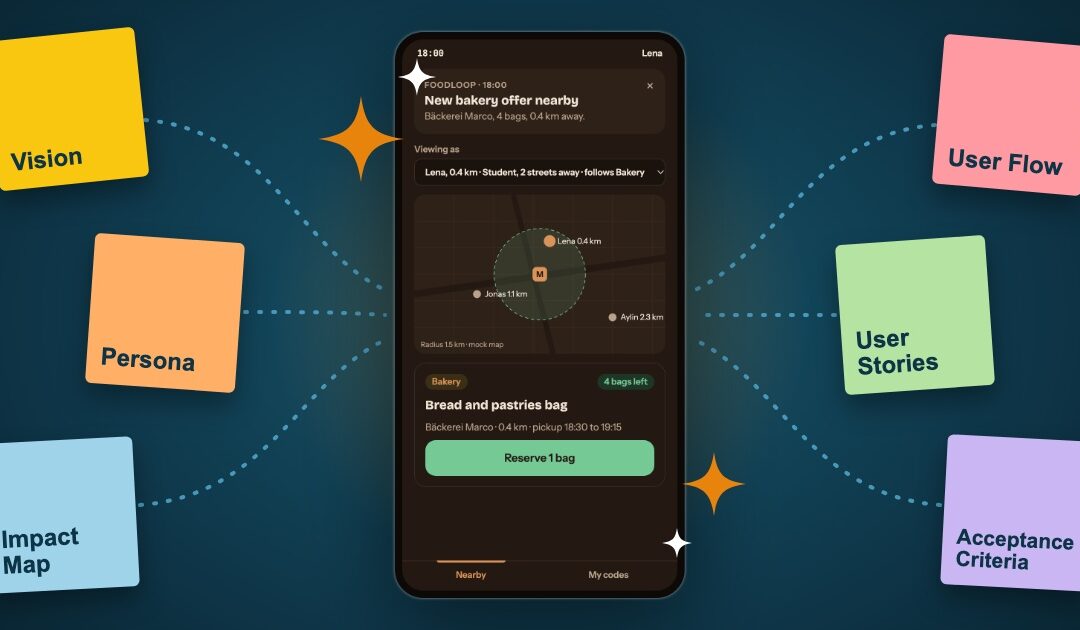
It fit better than I initially thought. The five phases of XRP almost perfectly align with Martin’s course levels. I therefore used the lecture as a bridge: On each phase slide, the students could see where they had already encountered the artifact in Martin’s course and whether XRP uses it as is, expands upon it, or adds something new. Two things in particular were new to them: the Impact Map as a prioritization technique and the Master Prompt, which translates all artifacts into a set of instructions for the prototyping tool.
The method traveled, I stayed in Zug. The lecture took place online and lasted about 45 minutes.
Thank you, Martin, for the invitation and for letting me show excerpts from your slides.
The video of the guest lecture
The recording is in English and runs just over 47 minutes. The chapters in the video description take you straight to each phase, to the live demo at 37:52 and to the error that only the prototype revealed, at 41:38.
What XRP Is: Five Phases in a Single Day
XRP takes a product idea through five phases and fifteen steps to a clickable prototype. In every step, the AI drafts the artifact, and the team decides what stays.
- FramingThe raw idea becomes an Elevator Pitch and a Product Vision Board.
- ElicitationStakeholder Map, Impact Map and the choice of the most important feature, together with a Persona.
- DocumentationUser Flow, User Stories with Gherkin Acceptance Criteria and a BPMN Diagram.
- ValidationA fresh AI chat acts as a critic and checks all artifacts against our checklist of eight of the twelve risks from the IREB AI4RE Study Guide. This is followed by a peer review without AI and the revision.
- BuildChoose the tool, write the Master Prompt, build the prototype and demo it.
The idea behind it is simple. A prompt alone leaves the AI guessing. Vision, Persona, User Stories and User Flow tell it who the product is for, what matters and what is out of scope. The Master Prompt condenses these artifacts into one single build instruction.
In the workshop, we build things using free tools so that no one has to sign up for a subscription. Currently, these are Banani for mockups and Google AI Studio for an app that’s already up and running. The tools, however, are constantly changing: In class, I mentioned Uizard for mockups, but since early November we’ve been working with Banani. This doesn’t change the steps of the method. The AI generates diagrams as XML, which can then be further edited in draw.io. If we used an image generator, the diagram could no longer be edited.
Where XRP Comes From: From Real-World Experience
I’ve been working in IT for over 20 years, much of that time in the financial industry, as a developer, technical lead, product owner, and department head. I’ve almost always served as a bridge between business and IT. From every role, I’ve taken with me a curiosity about the problem: What are the users’ pain points?
When ChatGPT became public at the end of 2022, I immediately asked myself what this means for Requirements Engineering. This led to talks on use cases, in 2024 among others at REFSQ and REConf, and eventually to a workshop format: from the raw idea through the artifacts of Requirements Engineering to a prototype you can demo. Matthias Herbert and I have run it with developers, Business Analysts and Requirements Engineers, as well as with people without a technical background.
So XRP is older than our AI4RE training. The Practical Day in AI4RE is XRP applied in the course.
Sold out at REConf, documented in the book
The method first proved itself at REConf in Munich. In 2025, Matthias and I offered the workshop “From Vision to Prototype in < 4 hours” there, and it was sold out by the end of January. In 2026, Jean-Pierre Berchez joined us, and once again the workshop was fully booked long before the conference. In the end, 19 people were in the room.
I wrote about XRP in the Swiss practitioner’s handbook “KI im Projektmanagement” (AI in Project Management) published by spm. My chapter is titled “Von der Idee zum Prototyp mit KI - Innovation in Stunden statt in Wochen” (From Idea to Prototype with AI: Innovation in Hours Instead of Weeks). It describes the version for conference workshops: four steps in four hours. The book is available directly from spm.
If you're familiar with the chapter, you'll notice an additional phase in the video. Today, validation has its own place before the building phase.
Today: the Practical Day in AI4RE
The four-hour workshop has grown into a full day. Today, XRP is the Practical Day of our AI4RE training for the IREB Micro-Credential. Matthias and I co-authored the official IREB AI4RE Study Guide, and the Practical Day puts into practice what the Theory Day teaches. With about seven hours available, I reorganized the phases, and four steps became fifteen.
Ideally, participants bring their own idea, a product or a problem from their everyday work. For everyone else, case studies are ready. One of them is FoodLoop.
The error that only the prototype revealed
FoodLoop is an app that combats food waste. In the evening, bakeries and stores list their leftover items, and people in the neighborhood reserve a bag and pick it up using a pickup code. The persona is Marco, 46, a baker in Zurich-Wiedikon.
Alongside the many runs in the course, I also had an AI agent play through the case study once. It took the team’s role on our workshop board, without a peer review. The example comes from this test run.
From the Master Prompt, Google AI Studio built a working app in a few minutes. Clicking through it, something stood out: Marco saw the pickup codes of all reservations in his list. Anyone standing next to him at the counter could read a code and collect someone else’s bag.
The AI had built exactly what we had specified. The error was in our own User Flow and therefore in the Master Prompt. The AI review in Phase 4 had found six weaknesses in the User Stories, but not this one. Only the prototype revealed it.
For the second version, I built FoodLoop as a Claude artifact that includes three corrections. Next to the app, it shows all User Stories with their Acceptance Criteria, and each criterion ticks off as soon as it has been exercised in the prototype.
Three Things to Take Away
- The artifacts provide context for the AI. Today's models are powerful enough. What makes the difference is what the AI knows about the product.
- The AI drafts, the team decides. Every AI artifact is a draft until someone has reviewed it. The responsibility remains with the team, regardless of how the artifact was created.
- A prototype can be tested and experienced. The Gherkin Acceptance Criteria are turned into test cases. And stakeholders click their way through their own process instead of reading a specification. This makes their feedback more concrete.
And next up: REFSQ 2027 in Basel
In April 2027, REFSQ, the international conference on Requirements Engineering, comes to Switzerland, to the FHNW Campus Dreispitz in Basel. We will run a special workshop there. That’s all I’m revealing for now.
Frequently Asked Questions
What is Extreme Rapid Prototyping (XRP)?
A method that takes a team, with AI as a sparring partner, from a product idea to a clickable prototype in one day. It leads through the artifacts of Requirements Engineering in five phases, from Elevator Pitch and Product Vision Board to the Master Prompt.
How long does XRP take?
On the AI4RE Practical Day, one day with about seven hours of working time. The conference workshop version, which is also in the book, needed four hours. Working through the method on your own, you can also take two or three days.
Do you need programming skills for this?
No. The prototyping tool writes the code. We have run XRP with developers as well as with Business Analysts and people without a technical background.
What tools are needed?
One AI chat for the artifacts and, for the Phase 4 review, a second, fresh chat. Free tools are enough for the build, currently Banani for mockups and Google AI Studio for a working app. Which tools fit best keeps changing.
Can confidential data go into the AI?
Not for free offerings. In those cases, the data can be used to train the models. This isn't a problem for a demo featuring a case study.
Where can I learn about XRP?
On the Practical Day of our AI4RE training, ideally with an idea of your own. Here are the dates.
AI structured it. The thinking and the final call are mine.

Michael (Mr. Miroboard) Mey
Michael is a trainer who not only impresses with his knowledge, but also with his passion.
To Michael’s Trainer profile
To his LinkedIn profile
 DE
 EN