
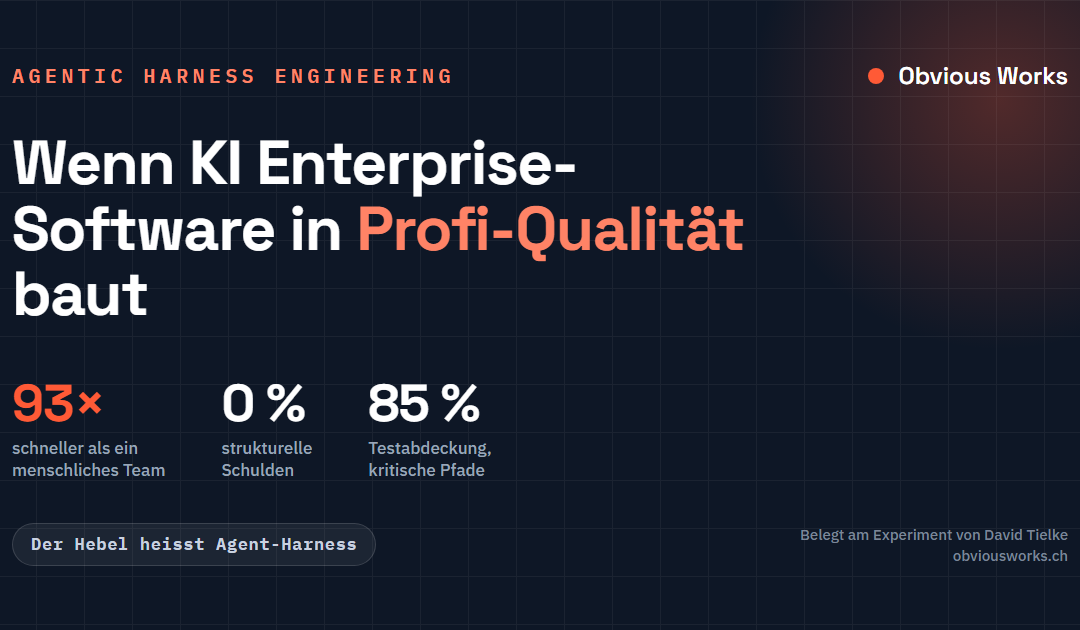
An experienced software architect rebuilt an entire enterprise application using AI: microservices, tests, documentation, and true quality standards. The result: zero technical debt, 85 percent test coverage, and—depending on how you calculate it—25 to 93 times faster than a human team. The key to this is called Agent-Harness. This is exactly the discipline we’ll teach you and your team.
Key Points at a Glance
- Software architect David Tielke has completely rebuilt his back-office application—which he had been maintaining for 18 years—using AI, expanding its functionality by about 12 to 15 times.
- The key to success was not a better model, but an agent harness: a set of rules that dictates HOW the AI builds, verified through automated code analysis.
- According to Tielke: 0 percent structural debt, 85 percent test coverage, and approximately 25,000 euros in team costs instead of an estimated 2 million euros.
- The catch: The Harness was so good because Tielke has decades of experience in architecture and quality. The fundamentals don't become obsolete; they become an asset.
If you work in professional software development, you’re familiar with that weary smile when you hear "AI builds an app for you." Sure, in the demo video, a to-do list clone is created in ten minutes. But you’re working with massive codebases, thousands of requirements, real enterprise architectures, and quality standards where a toy like that doesn’t even come into play.
That is why the self-experiment by David Tielke So interesting. Tielke is a freelance consultant and trainer in software architecture who has been an established figure in the German-speaking .NET and enterprise communities for years. He’s not a hype-monger, but rather someone who conducts architecture reviews for major clients. In his video, he documents an experiment that he himself describes as shocking. We take his figures for what they are: a very carefully conducted one-off experiment.
And we're not writing this as mere spectators. For us, the discipline behind this result has a name and a track record: Agentic Harness Engineering. Our Head of AI & Agentic Coding, Matthias Herbert, has been teaching them for months, described them in a guest lecture at the University of Bern, and is a co-developer of the AI4RE micro-credential. We’ve already trained over 400 developers. Tielke’s experiment isn’t news to us—it’s rather an impressive confirmation on a large scale: the key lies not in the prompts, but in the harness. That’s exactly what we’re taking away from his experiment, and we’ll show you what it means for your team.
Not just a weekend prototype, but a real system
Tielke developed his personal back-office application from the ground up—not as a clone, but with a feature set roughly 12 to 15 times more extensive. The goals he set for himself: as much AI as possible, a true enterprise architecture, and the same quality standards he applies to his most demanding client projects. According to his own account, the result is:
That's the workload that entire teams at Tielke have been handling for years.
What is an agent harness?
An agent harness is a set of rules that doesn’t tell the AI WHAT to build, but HOW. It includes architectural specifications, coding guidelines, testing and documentation standards, as well as automated testing tools that immediately evaluate every change against these specifications. The harness makes AI results controllable because it makes them measurable.
The specification (the WHAT) and the harness (the HOW) are separate. A system prompt is generated from the harness files at the start of each new session, so that the AI knows exactly which rules to follow in each session.
The key point: Tielke did not leave control to the AI. He built static analysis tools into the harness that automatically check the generated code against the architecture and coding guidelines. In his case, this consists of a set of 880 architectural rules from a real customer project, plus a comprehensive coding guideline. If the code deviates, it is not a human who corrects the code, but the harness. Tielke calls this Harness Correction Development: You're not fixing the symptom; you're sharpening the guardrail so that the deviation never happens again.
Why is this possible right now, of all times?
Tielke dates the turning point to late 2025 or early 2026. Before that, the models tended to follow guidelines rather loosely; especially in large projects, they would eventually veer off course. According to Tielke, this has changed with the new generation of models: The models suddenly adhere meticulously to extensive, detailed specifications and guardrails.
That may sound like a minor detail, but it makes all the difference. Only when a model truly sticks to your rules can you give them broad guidelines and trust that the application will be built the way you want it to be. A harness is only as good as the model’s commitment to it.
From Developer to Stakeholder
The most fascinating part is how Tielke’s own role shifted over the course of the experiment. Phase by phase, he gradually stepped back from the detailed work. Humans move up the ladder of abstraction, while AI takes over the levels below.
A developer became an architect, then a product owner, then a stakeholder. This is precisely the shift in responsibilities that professional teams need to prepare for right now.
AI with Harness Takes on a Human Team
Tielke compared his results against two actual client teams and had both teams estimate the effort involved. Here is the comparison, as he reported it.
| Key figure | AI with Harness (Tielke) | Human Team (Estimate) |
|---|---|---|
| Effort | 45 workdays | Approx. 19 person-years (4,180 days) |
| Costs | about 25,000 euros | about 2 million euros |
| Structural Debt | 0 percent | about 13 percent |
| Test Coverage | 85 percent Critical paths, deliberately chosen | about 60 percent |
| Documentation | completely | about 33 percent |
Why only 85 percent of the tests? Because this 85 percent covers precisely the application’s critical paths—the backend and the workflows. The missing 15 percent is not a quality gap, but a deliberate decision: Tielke did not artificially simulate workflows triggered from external sources, such as Office 365 or Outlook. Achieving 100 percent coverage would have been feasible, but the effort required was not worth the benefit. By comparison, the two human teams cover about 60 percent.
The 25,000 euros consist of 45 days of work (at a standard full-cost rate) and the actual AI subscription costs of around 1,600 euros. This results in his headline-grabbing factor: 93 times faster than the human team.
And now the part we like about Tielke: He argues against it himself. If you exclude tests and documentation, it might still be a factor of 60. Give the teams more time for the estimate and be strict with yourself, and you’ll end up with a factor of 25. Even under this most conservative interpretation, you’re still left with a team that’s 25 times slower, with poorer test coverage and more technical debt.
It's a single experiment, not a study. But it's a single experiment by someone who has spent half his life measuring software quality. That makes it hard to dismiss.
Why can't everyone just do that?
The tempting interpretation would be: "So now anyone can build enterprise software." Tielke himself says the opposite.
The end result is so good because I put so much time and energy into the harness. AI is a great tool once you understand the basics of software development and architecture.
That's exactly the point. The Harness was so good because Tielke has known for decades how to define architectural and quality standards for a team. It's a short step from there to defining standards for AI. Without that foundation, it's not.
In other words: The fundamentals of software architecture and quality aren’t becoming obsolete—they’re becoming an asset. Those who master them can build a harness that controls AI at the enterprise level. Those who don’t master them will end up with exactly the mess everyone is warning about.
You can learn the harness. That's exactly what we teach.
Tielke’s result didn’t come from a trick, but from 45 nights of hard work and over 20 years of architectural experience that went into his Harness. That’s the bad news for anyone hoping to pick this up in an afternoon by watching a few videos. And here’s the good news if you want to take a shortcut: We’ll build the Harness with your team on your actual tech stack—independent of any specific methodology or model—in weeks rather than years. You don’t have to reinvent the wheel on your own; you’ll adopt a proven method and apply it to your code right away.
AI Developer Bootcamp
Over the course of three months, you’ll work with us to build out the entire process—from micromanagement to spec- and test-driven development using a real test harness. For teams that want to integrate AI into their development process permanently and in a standardized way.
To the BootcampAgentic Coding Hackathon
Two to three days working on your own code. You'll set up an initial working test suite and walk away with a tangible result. It's the perfect way to test the approach on your actual codebase before making a major investment.
About the HackathonAgent Harness and the Experiment: A Brief Explanation
What is an agent harness?
An agent harness is the set of rules that tells an AI how to build software: architecture, coding guidelines, testing and documentation standards, plus automated verification tools that check every change against these specifications. It separates the HOW (harness) from the WHAT (specification).
What did David Tielke do in his experiment?
He completely rebuilt his back-office application—which had been in use for 18 years—using AI, turning it into a microservices system with enterprise architecture, testing, and documentation, and compared the effort involved with that of two real client teams. Details are in his video, "The Moment That Changed Software Development!".
Is the factor of 93 realistic?
It is a carefully conducted individual experiment, not a study, and Tielke himself conservatively scales it down by a factor of 25. Even this cautious figure represents a significantly faster and higher-quality result than that of the human control group.
Can anyone develop like that?
No. Tielke emphasizes that quality stems from his decades of experience in architecture and quality assurance. A harness is only as good as the person who writes it. That is why the fundamentals remain crucial—and why they can be learned.
How do I learn Agentic Harness Engineering?
In the AI Developer Bootcamp over three months with your team, or in the Agentic Coding Hackathon as a quick sprint on your own codebase. If you're unsure which format is right for you, Send us a quick message.
Source and further reading: David Tielke, "The Moment That Changed Software Development!", YouTube, youtu.be/eLDHrqKplVI. All figures cited are taken from Tielke's own account of his experiment and should be understood as such.

Matthias (AI Ninja)
Matthias puts his heart, soul and mind into it. He will make you, your team and your company fit for the future with AI!
About Matthias Trainer profile
To his LinkedIn profile
 DE
DE  EN
EN